
Thailand is developing an 873km high-speed rail project that will connect Bangkok with the Laos-China railway. Once completed, it will be possible for people and goods to travel from Bangkok to Kunming, the capital of China’s Yunnan province. The project is expected to be completed by 2028.
Key Takeaways
- The high-speed rail project in Thailand, part of China’s Belt and Road Initiative, will significantly reduce travel time and enhance regional connectivity.
- The Pan-Asian rail network, involving Thailand, Laos, and Malaysia, has the potential to transform infrastructure and trade connectivity in the region.
- China’s expanding railway investments in Southeast Asia, including the new rail network to Vietnam and the high-speed railway in Indonesia, indicate a growing focus on regional transportation and economic integration.
The railway — which is estimated to cost between US$5 billion and US$9.9 billion — is part of China’s Belt and Road Initiative (BRI), a global development strategy adopted by the Chinese government in 2013 to enhance regional connectivity and embrace a brighter economic future. It aims to strengthen infrastructure, trade, and investment links between Asia, Europe, and Africa along two main components: the Silk Road Economic Belt and the 21st Century Maritime Silk Road.
Phase one will be to connect Bangkok to Nakhon Ratchasima, the gateway to northeast Thailand. The second phase of the project will see the railway connect to Nong Khai, a border town in northeast Thailand and across the border from Vientiane, the capital of Laos.
Through the new Thai-China railway, travel time from Bangkok to Nakhon Ratchasima will be reduced to 90 minutes from the current 4.5 hours.
For Thailand, the railway offers the potential for increased integration with China and other countries in the region. The administration of Thai Prime Minister Srettha Thavisin has pledged to expedite the construction to achieve these ambitious goals.
Southeast Asia and the Pan-Asian rail network
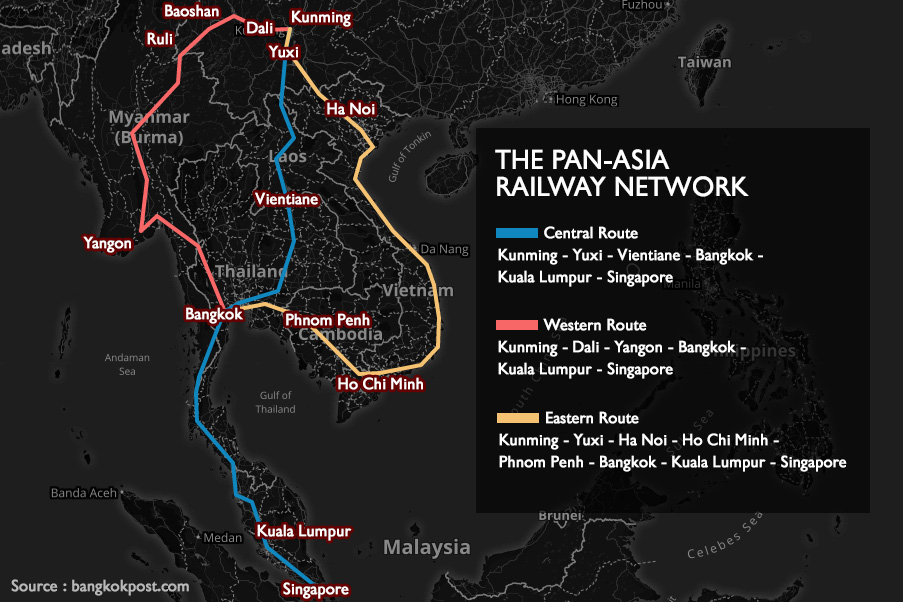
Thailand, Laos, and Malaysia will be key players in the success of the Pan-Asian rail network, a comprehensive rail network that will unite China, Singapore, and the mainland Southeast Asian countries.
In December 2021, Laos and China inaugurated the Boten-Vientiane railway. This 414km electrified high-speed railway runs between the capital Vientiane, and the town of Boten on the Laos-China border. At Boten, the line heads north some 595km before ending in Kunming.
The Vientiane line is an integral section of the Pan-Asian rail network, which has three routes: the central route from Kunming to Laos and finally Bangkok; the western route which extends through Myanmar and Thailand; and the eastern route crossing Vietnam, Cambodia, and Thailand before connecting in Bangkok and extending southwards towards Malaysia and Singapore.
The China-Laos railway has registered over 30 million passengers and over 34 million tons of cargo since its inception, including over 7.8 million tons of cross-border cargo. As such, the railway has the potential to transform Laos from a landlocked country that was the least industrialized in ASEAN into a land-linked hub that connects to the wider region. Infrastructure-poor Laos previously had only four kilometers of the railway before the completion of the Boten-Vientiane railway.
According to a World Bank report, transit trade through Laos could reach 3.9 million tons by 2030 from 1.6 million tons in 2016 and shift an estimated 1.5 million tons of maritime transport to the railway.
China’s expanding railway investments in Southeast Asia
China has been active in expanding its rail network into Southeast Asia. In 2022, the country launched a new rail network that connected Chengdu and Chongqing to Vietnam’s Hanoi. The route reduces transportation time from an average of 20 days to five.
The Chongqing-Hanoi freight train route is part of the New International Land-Sea Trade Corridor (ILSTC), a trade and logistics passage developed by the western Chinese provinces of Chongqing, Guangxi, Guizhou, Gansu, Qinghai, Xinjiang, Yunnan, and Ningxia and Singapore.
With Chongqing as the transport hub, the ILSTC integrates rail, maritime, and road transportation – which connects southwestern China with the rest of the world via the Qinzhou Port in Guangxi. There, goods are shipped to ports across the world.
Moreover, China also helped finance and develop Indonesia and Southeast Asia’s first high speed railway that connects the capital Jakarta to the city of Bandung, 142km east. This has reduced traveling time from 2-3 hours by conventional railway to 40 minutes.
Indonesia’s railway master plan opens a wide range of opportunities for foreign investors, especially as the country aims to extend its railway network to over 10,000km by 2030, an increase from just 4,814km recorded in 2014. The increase in the rail network includes over 3,000km of urban railway. An estimated US$52 billion is required to accomplish this master plan. Indonesia needs to advance its railway network to promote economic development, ensure nationwide connectivity, and reduce logistics costs, which are the highest in the region.
ASEAN Briefing is produced by Dezan Shira & Associates. The firm assists foreign investors throughout Asia and maintains offices throughout ASEAN, including in Singapore, Hanoi, Ho Chi Minh City, and Da Nang in Vietnam, in addition to Jakarta, in Indonesia. We also have partner firms in Malaysia, the Philippines, and Thailand as well as our practices in China and India. Please contact us at asean@dezshira.com or visit our website at www.dezshira.com.


