
Digital innovation is accelerating across the global financial system, and a new analysis from experts affiliated with the Bank for International Settlements highlights how fintech, big-tech platforms, crypto assets and tokenization are reshaping the landscape.
Key takeaways
- Fintech, big tech and crypto innovations are rapidly reshaping global finance, pushing traditional banks into both competition and collaboration.
- Public-sector payment infrastructures like Pix and UPI show that broad, inclusive innovation succeeds when systems are interoperable and policy-led.
- As digital finance expands, strong regulation and coordinated public–private action are essential to prevent new risks from destabilizing the financial system.
The core message: fintech firms will increasingly compete with, and cooperate alongside, traditional banks, but only forward-looking public policy can ensure innovation delivers broad-based benefits.
Over the past decade, fintech companies and large digital-platform firms have pushed into services once dominated by banks, insurers and asset managers. Payment apps, merchant-credit platforms, AI-driven underwriting and crypto-based financial services have all challenged incumbents.
Yet the report stresses that disruption rarely ends in outright replacement. Instead, early substitutes often evolve into complementary services that expand competition, diversify markets and force incumbents to innovate.
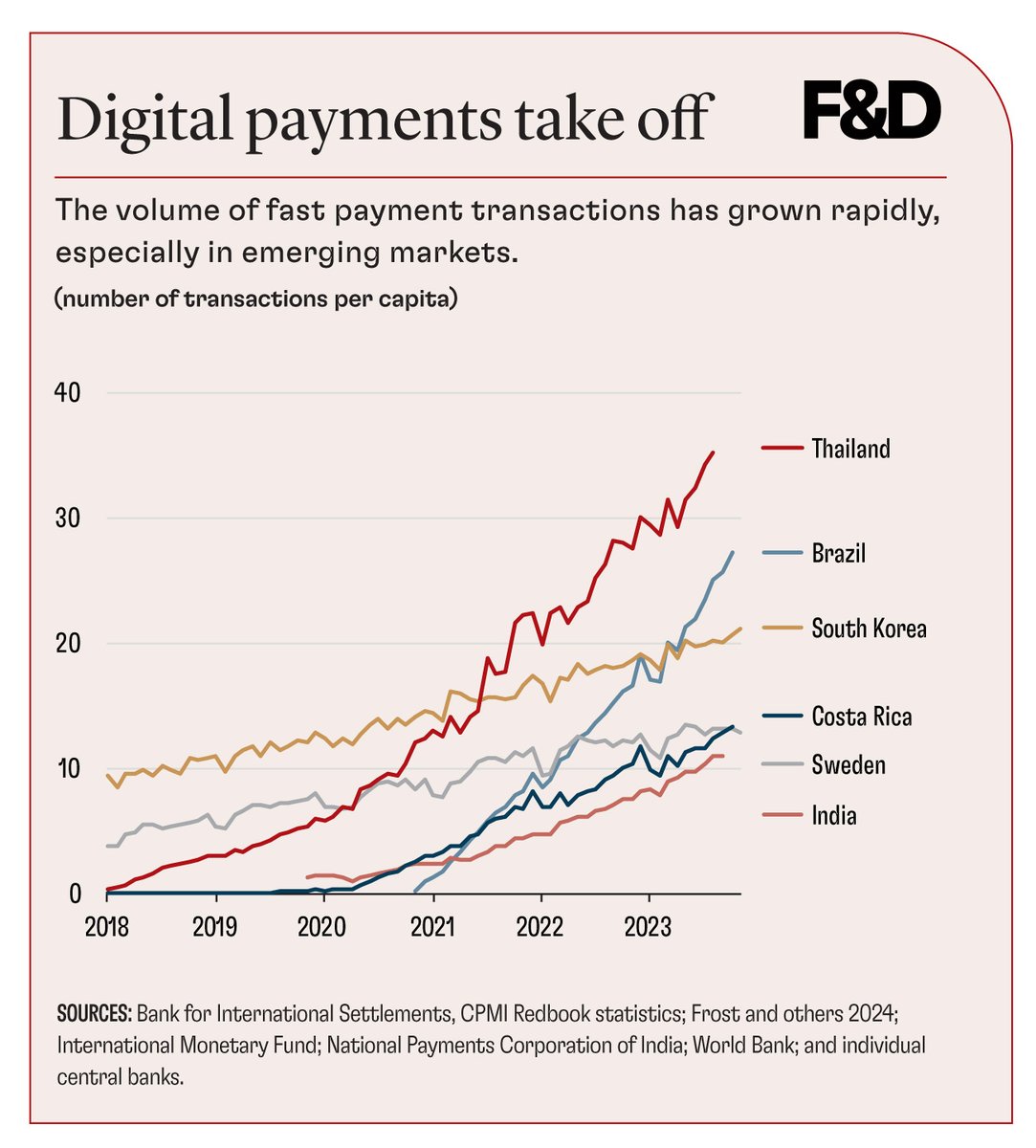
Payments remain the clearest example of this shift. Fast, low-cost, real-time payment systems have taken off worldwide, particularly in emerging markets. Public infrastructure has proven decisive: Brazil’s Pix and India’s Unified Payments Interface (UPI) now serve vast majorities of their populations, powering retail transactions, bill payments and small-merchant commerce.
Their success contrasts sharply with fragmented systems elsewhere, such as the United States, China and Peru. where competing private wallets operate in “walled gardens,” limiting interoperability and prompting policy intervention.
Thailand has established itself as a pioneer in digital payment solutions
Thailand has emerged as a leader in digital payments, driven by its PromptPay system and strong regulatory support for QR-based transactions. PromptPay’s nationwide reach, simple onboarding, and cross-border payment links with Singapore and Malaysia have made Thailand one of the world’s most advanced real-time payment ecosystems. Its rapid adoption, across consumers, SMEs and government services, demonstrates how inclusive infrastructure and policy coordination can accelerate digital financial transformation.
1. PromptPay: The National Game-Changer
The single most significant driver of Thailand’s digital payment success is PromptPay.
- Interoperable System: Launched by the Bank of Thailand (BOT) and the Thai Bankers’ Association, PromptPay is a real-time, interbank payment system. It allows users to transfer and receive money instantly, 24/7.
- Simple Proxy: Its genius lies in its simplicity: users can link their bank account to a mobile phone number or national ID number (instead of a complex account number).
- High Adoption & Low Cost: It has achieved massive registration (over 77 million registered IDs) due to its zero-fee structure for small-to-moderate transactions, which has been crucial for boosting financial inclusion and accelerating the shift away from cash.
2. QR Code Ubiquity
Thailand has standardized a Thai QR Code across virtually all banks, merchants, and digital wallets.
- Universal Acceptance: This standardization means a customer can use any banking app or e-wallet to scan a merchant’s single QR code, fostering seamless transactions even at small businesses, street vendors, and markets.
- Mobile-First: This has made mobile banking apps and digital wallets the preferred payment method for a majority of transactions.
3. Inter-Country Connectivity (Cross-Border Payments)
Thailand’s central bank (BOT) has been a global leader in linking its national payment system with those of other countries.
- PromptPay-PayNow Link: The successful connection between Thailand’s PromptPay and Singapore’s PayNow allows for instant, low-cost cross-border transfers between the two countries using only a mobile number.
- Regional Expansion: Thailand is actively expanding this connectivity with other ASEAN nations (including Indonesia, Malaysia, Vietnam, and Cambodia), positioning itself as a hub for regional digital finance.
4. Fintech Ecosystem and E-Wallets
Alongside the national system, a vibrant private sector has flourished.
- Leading Wallets: Major e-wallets like TrueMoney, Rabbit LINE Pay, and ShopeePay have secured huge user bases by integrating deeply into daily life, offering services from bill payments and e-commerce to transit payments.
- Digital Innovation: The success of the underlying infrastructure has spurred further innovation, including pilot projects for a Central Bank Digital Currency (CBDC) and the planned introduction of Virtual Bank licenses to intensify competition.
In essence, Thailand’s commitment to creating an interoperable, accessible, and low-cost national payment rail has successfully leapfrogged it past many more developed economies in terms of digital transaction volumes and adoption rates.
Innovation is also reshaping credit markets. Early fintech lenders experimented with alternative data and digital platforms, but big-tech firms dramatically expanded the space with merchant-based lending.
These models have improved credit access for underserved borrowers, from small businesses in Argentina to high-unemployment regions in the United States. Incumbent banks have responded by adopting similar technologies, while many fintech challengers, including Revolut and Nubank, have become regulated banks themselves.
Crypto assets and decentralized finance, meanwhile, promise a more radical break from institutional finance, though the authors note that markets remain heavily intermediated and risk-prone. Stablecoins, despite their ties to traditional assets, introduce vulnerabilities of their own, including fraud, financial-integrity concerns and potential threats to monetary sovereignty.
Against this backdrop, the report warns that innovation alone is insufficient. Emerging risks, from crypto-market spillovers to financial-stability concerns, require robust public infrastructure, clear regulation, and collaborative experimentation between the public and private sectors. Projects like Agorá, which brings central banks and commercial banks together to explore tokenized cross-border payments, illustrate the direction of travel.
The takeaway is clear: innovation is transforming finance, but only coherent policy and coordinated action can ensure the transformation strengthens, rather than destabilizes, the global financial system.


